 |
Q.ANT Native Computing Toolkit 2.3.1
All you need for photonic computing
|
|
Q.ANT Native Computing Toolkit 2.3.1
All you need for photonic computing
|
#include <stddef.h>#include <stdint.h>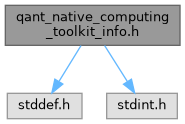
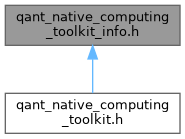
Go to the source code of this file.
Classes | |
| struct | QantSensorInfo |
| struct | QantVersionInfo |
| struct | QantPerformanceCounterInfo |
| Struct to hold performance counter information. More... | |
Macros | |
| #define | QANT_NATIVE_COMPUTING_TOOLKIT_MAJOR_VERSION 2 |
| #define | QANT_NATIVE_COMPUTING_TOOLKIT_MINOR_VERSION 3 |
| #define | QANT_NATIVE_COMPUTING_TOOLKIT_DEFAULT_CHAR_ARR_LENGTH 1024 |
Functions | |
| int | setup_logging (char const *folder_name, int const loglevel) |
| Enables logging. | |
| int | get_driver_info (const uint32_t npu_id, char *output, size_t len) |
| Gets detailed information about the Q.ANT native computing driver and its direct dependencies. | |
| QantSensorInfo | get_sensor_info (const uint32_t npu_id) |
| Get detailed information about the NPU sensors, e.g. temperature. | |
| QantVersionInfo | get_version_info (const uint32_t npu_id) |
| Gets information about the firmware versions. | |
| int | get_available_npus (uint32_t *idxs_out, char(*serials_out)[QANT_NATIVE_COMPUTING_TOOLKIT_DEFAULT_CHAR_ARR_LENGTH], size_t capacity, size_t *out_count) |
| Get all available NPUs. | |
| int | reset_perf_counter (const uint32_t npu_id) |
| Reset the performance counters. | |
| int | get_perf_counter (const uint32_t npu_id, QantPerformanceCounterInfo *out) |
| Gets the performance counters. | |
| #define QANT_NATIVE_COMPUTING_TOOLKIT_DEFAULT_CHAR_ARR_LENGTH 1024 |
| #define QANT_NATIVE_COMPUTING_TOOLKIT_MAJOR_VERSION 2 |
| #define QANT_NATIVE_COMPUTING_TOOLKIT_MINOR_VERSION 3 |
| int get_available_npus | ( | uint32_t * | idxs_out, |
| char(*) | serials_out[QANT_NATIVE_COMPUTING_TOOLKIT_DEFAULT_CHAR_ARR_LENGTH], | ||
| size_t | capacity, | ||
| size_t * | out_count ) |
Get all available NPUs.
| idxs_out | Array to place the (pcie-enumeration) idxs of the available NPUs, length: capacity. |
| serials_out | Array to place the NPU serial numbers, length: capacity. |
| capacity | Length of idxs_out, serials_out. Should be chosen at least as large as the expected number of available NPUs. |
| out_count | The actual number of available NPUs. |
| int get_driver_info | ( | const uint32_t | npu_id, |
| char * | output, | ||
| size_t | len ) |
Gets detailed information about the Q.ANT native computing driver and its direct dependencies.
| npu_id | The identifier of the NPU on which to perform the operation. |
| output | A preallocated memory to store the info string into. |
| len | The maximum length of the string. |
| int get_perf_counter | ( | const uint32_t | npu_id, |
| QantPerformanceCounterInfo * | out ) |
Gets the performance counters.
| npu_id | The identifier of the NPU on which to perform the operation. |
| out | A preallocated memory to store the counter info. |
| QantSensorInfo get_sensor_info | ( | const uint32_t | npu_id | ) |
Get detailed information about the NPU sensors, e.g. temperature.
| npu_id | The identifier of the NPU on which to perform the operation. |
| QantVersionInfo get_version_info | ( | const uint32_t | npu_id | ) |
Gets information about the firmware versions.
| npu_id | The identifier of the NPU on which to perform the operation. |
| int reset_perf_counter | ( | const uint32_t | npu_id | ) |
Reset the performance counters.
| npu_id | The identifier of the NPU on which to perform the operation. |
| int setup_logging | ( | char const * | folder_name, |
| int const | loglevel ) |
Enables logging.
Log messages are written to stdout and to a file
| folder_name | The folder where the log files are created. Individual logfiles are created with a timestamp. |
| loglevel | The logging level, from 0 = tracing to 4 = error only. |
 1.17.0